
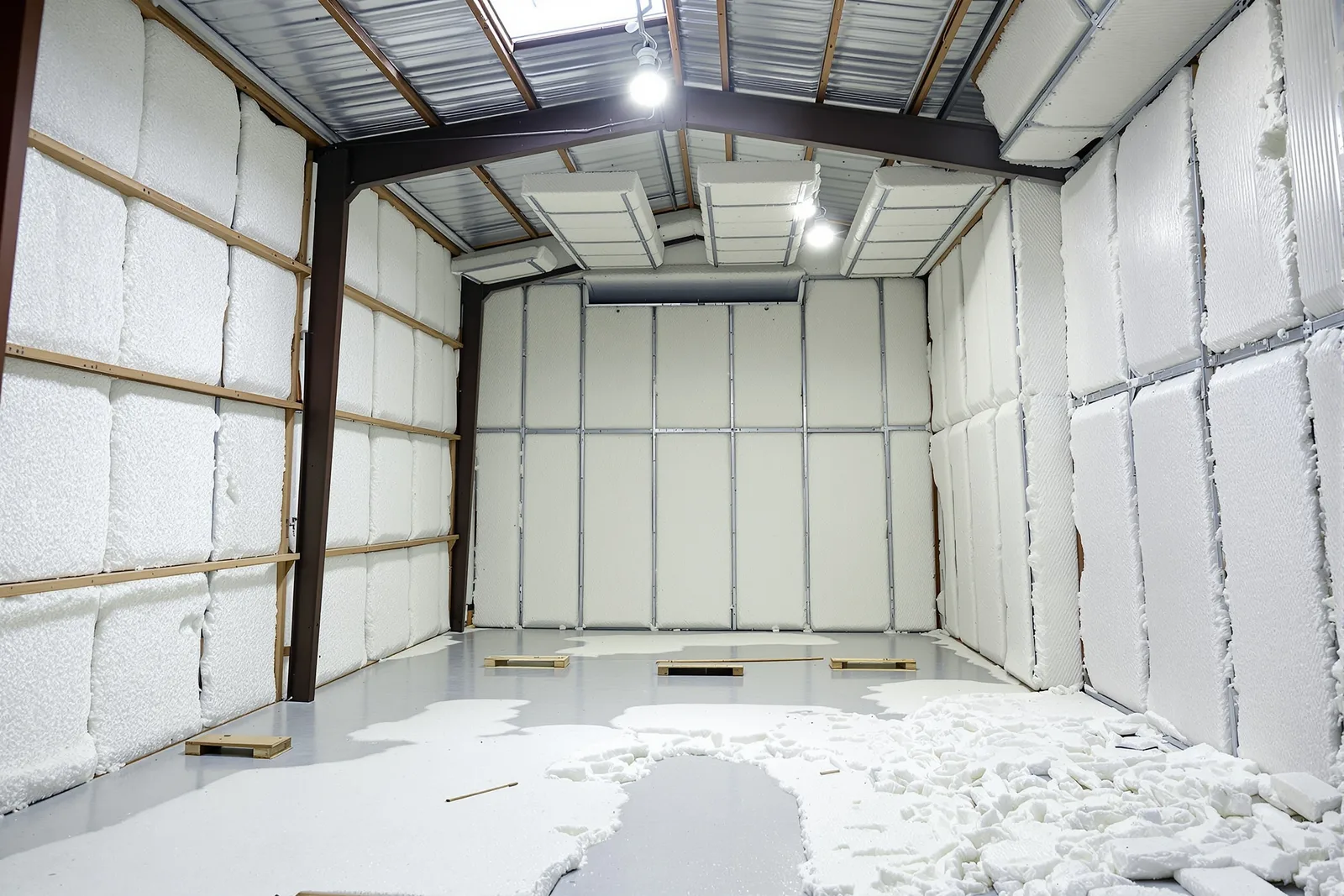
Metal Building Insulation Cost in Texas: Fiberglass, Vapor Barrier and Spray Foam
Part of our Metal Buildings guide.

Short answer: published guides put metal building insulation at about $0.50 to $4.50 per square foot installed, depending on the type (HomeGuide, November 2025). Fiberglass batts and rolls run about $0.80–$2.60 per square foot, spray foam about $1.00–$4.50, rigid foam board about $1.20–$3.70 and reflective insulation about $0.50–$2.20. Closed-cell spray foam doubles as the vapor barrier; fiberglass needs a vapor-retarder facing or a separate barrier on the warm side. What your building needs is set by its use and by the energy code your city enforces.
Ready to build? Get a quote from our metal building team
Metal Building Insulation Cost per Square Foot (2026)
Two published guides give current installed ranges. They differ, which is normal for cost guides; use them to sanity-check a quote, not to replace one.
HomeGuide (November 2025), installed, per square foot: spray foam $1.00–$4.50; batts and rolls $0.80–$2.60; foam board $1.20–$3.70; blown-in $0.90–$2.40; reflective $0.50–$2.20. By the board foot (1 square foot, 1 inch thick), closed-cell spray foam runs $1.30–$2.90 and open-cell $0.60–$1.30. Insulation contractors charge $0.50–$1.40 per square foot for labor, per the same guide.
BuildingsGuide (October 2026), installed, per square foot: fiberglass batts or rolls $0.70–$2.50; spray foam $2.50–$4.50; structural insulated panels $5–$10.
Whole-building spray foam, walls and roof (HomeGuide): about $2,600–$13,500 for a 30x40, $4,500–$22,100 for a 40x60 and $8,200–$39,600 for a 50x100. The width of those ranges is mostly foam type and thickness.
UTS BuildPros planning ranges (2026, not a quote): fiberglass with a vapor retarder $1.50–$3.00 per square foot of wall and roof area, closed-cell spray foam $3.00–$6.00, and a radiant barrier $0.50–$1.50 added. They sit above the low end of the published ranges, so compare the R-value, facing and seam sealing each quote includes, not just the rate.
Vapor barrier cost. We did not find a published guide that prices a vapor retarder on its own per square foot. On metal buildings it is usually the facing laminated to the fiberglass, so its cost is inside the fiberglass price; closed-cell spray foam at sufficient thickness acts as its own. Where a separate barrier or liner is needed, ask for it as its own line on the quote. For where insulation sits in a whole-building budget, see our 30x40 line-by-line cost breakdown and costs by building size.
Why Metal Buildings Need Specialized Insulation
Metal buildings present unique insulation challenges that wood-framed structures do not. Steel framing creates thermal bridges -- direct pathways for heat to bypass insulation and enter the interior. Condensation is another major issue. When warm, humid Texas air hits cool steel surfaces, moisture forms. Without a vapor barrier and proper insulation, that condensation leads to rust, mold, and degradation of stored materials.
The Texas climate amplifies both problems: long, hot summers drive heat through the roof, the Gulf Coast and East Texas are humid for much of the year, and winter cold snaps -- like the 2021 freeze -- can burst pipes in poorly insulated buildings. For any building people work in or that stores something that can be damaged, insulation is part of the building, not an extra.
Fiberglass Batt Insulation: The Budget Option
Fiberglass batt insulation is the most common and affordable option for metal buildings. It comes in rolls or pre-cut batts designed to fit between steel framing members. For walls, R-13 to R-19 batts are standard. For roofs, R-19 to R-30 is recommended depending on your climate zone. Code minimums for metal buildings are set by assembly, not by batt thickness alone; see the climate zone section below.
As a UTS BuildPros planning range for 2026, fiberglass batt insulation in a metal building runs $1.50 to $3.00 per square foot of wall and ceiling area. For a 4,000-square-foot building, that is $6,000 to $12,000. The downside is that fiberglass does not seal air gaps well, so you will still have thermal bridging through the steel framing and air leakage around panel seams. It also compresses easily, reducing effectiveness if not installed carefully.
Spray Foam Insulation: The Premium Solution
Spray polyurethane foam, or SPF, is the gold standard for metal building insulation in Texas. It is applied as a liquid that expands to fill every gap, seam, and cavity, creating a seamless air barrier with no thermal bridging. Closed-cell spray foam -- the type we recommend for metal buildings -- has an R-value of approximately R-6.5 per inch and acts as its own vapor barrier.
For a metal building in Texas, we typically apply 2 to 3 inches of closed-cell foam to walls and 3 to 4 inches to roofs. At roughly R-6.5 per inch, that is about R-13 to R-19.5 on walls and R-19.5 to R-26 on roofs, with the air sealing that batts cannot provide. Whether that meets code depends on the assembly requirements of your city's energy code, so it is checked in the energy compliance documentation, not assumed. Installed cost runs higher than fiberglass, often about double, and is priced per project.
Whether the premium pays back depends on how many hours the building is conditioned, your electricity rate and how leaky the alternative would be. For a building that is air-conditioned every working day, air sealing is where most of the benefit comes from. Ask for an energy model or at least a load calculation for both options before you choose on price alone.
Reflective Radiant Barriers: A Smart Addition
Radiant barriers are reflective materials -- usually aluminum foil laminated to a substrate -- installed on the underside of the roof to reflect radiant heat away from the interior. In Texas, where solar heat gain through the roof is a large part of the cooling load, a radiant barrier facing an air space reduces the radiant heat that reaches the insulation below.
Radiant barriers work best in combination with traditional insulation. They do not replace insulation -- they supplement it by addressing the radiant heat component that fiberglass and foam do not block effectively. The added cost is modest compared with the insulation itself, which is why they are worth pricing as an alternate on a Texas metal building.
Vapor Barriers and Condensation Control
Condensation is the silent killer of metal buildings in humid climates. When warm, moist air contacts cool steel, water droplets form on interior surfaces. Over time, this causes rust on the steel frame, mold on insulation and interior finishes, and damage to stored equipment, inventory, and vehicles.
A proper vapor barrier is essential. In spray foam applications, closed-cell foam acts as its own vapor barrier when applied at sufficient thickness. In fiberglass applications, a separate polyethylene vapor barrier must be installed on the warm side of the insulation -- the interior in Texas. The vapor barrier should have a perm rating of 1.0 or less and must be sealed at all seams, penetrations, and edges with appropriate tape.
Roof ventilation also plays a role. Even with excellent insulation, some heat will reach the roof interior. Proper ventilation -- ridge vents, eave vents, or powered exhaust fans -- removes hot, moist air before it can cause problems. For large commercial metal buildings, we often specify powered ventilation systems with thermostatic and humidistatic controls.
R-Value Requirements by Texas Climate Zone
Two things set the requirement: the climate zone of your county and the edition of the energy code your city has adopted. Texas runs from Climate Zone 1 in the far south to Zone 4 in the Panhandle, and the 2021 IECC map moved many counties warmer; Dallas/Fort Worth moved from Zone 3 to Zone 2 (the North Central Texas regional amendments address how that applies locally). Editions differ city by city: Texas's statewide commercial minimum is still the 2015 IECC, Fort Worth uses the 2015 edition, Dallas and Houston the 2021 edition, and Austin, Plano and Irving the 2024 edition.
For commercial buildings, the IECC lists metal-building requirements as assemblies in Table C402.1.3: roofs are typically a filled-cavity or liner system (for example R-19 + R-11 LS), and walls generally need continuous insulation in addition to R-13 in the cavity, with the amount varying by edition and zone. Because steel framing bridges heat around the insulation, the honest way to know a design complies is to run it through COMcheck for the edition your city enforces, which is what the permit reviewer will look at.
Insulation for Specialized Uses
Different building uses have different insulation needs. A climate-controlled office or retail space needs the highest insulation levels, set by the energy code assembly requirements above, plus a tight building envelope and high-efficiency HVAC. A workshop or garage where people work intermittently can get by with R-13 walls and R-19 roofs, supplemented by good ventilation and spot cooling.
Agricultural buildings storing hay, equipment, or livestock have unique requirements. Hay storage needs ventilation to prevent spontaneous combustion, so insulation must be paired with adequate airflow. Livestock barns need insulation for animal comfort but also need washable interior surfaces and moisture-resistant materials. Cold storage for produce or meat is a specialized envelope, usually insulated metal panels with the vapor control and refrigeration designed together.
Signs Your Metal Building Needs Better Insulation
Not sure whether your existing metal building is under-insulated? The warning signs are easy to spot. If the interior temperature spikes past 100 degrees on a hot afternoon even with the doors closed, your insulation is not keeping up. If you see condensation beading on the walls or roof after a cold night, moisture is getting through. If your cooling bills climb every summer while the space never feels comfortable, the thermal barrier is failing.
Rust streaks on interior steel, musty odors, and mold around the base of the walls are also red flags that moisture is trapped in the envelope. In a workshop or warehouse, stored equipment that sweats or corrodes is a sign the building is not staying dry. If you are noticing any of these, the fix is usually a proper insulation and vapor barrier system rather than a bigger air conditioner — a retrofit that pays for itself in lower energy costs and longer equipment life.
Cost vs. Benefit: Making the Right Choice
Insulation is one of those areas where cutting corners costs more in the long run. An under-insulated metal building in Texas will have higher energy bills, shorter HVAC equipment life, condensation damage, and uncomfortable working conditions that reduce productivity. The upfront cost difference between basic fiberglass and premium spray foam is significant -- but so is the long-term performance difference. For where insulation sits in the total budget, see our line-by-line Texas metal building cost breakdown.
At UTS BuildPros, we help clients choose the right insulation strategy based on their building use, budget, and long-term plans. For buildings that will be climate-controlled and occupied daily, we recommend spray foam every time. For buildings used seasonally or for storage, fiberglass with a radiant barrier may be the smarter economic choice. We never recommend skipping insulation entirely -- even for basic storage buildings, some insulation protects against condensation and temperature extremes.
If you are planning a metal building in Texas, Oklahoma, or Arkansas, see our metal building services, call (940) 231-2640 or request a quote. We will look at your climate zone, building use and budget and price the insulation as its own line.
Sources
HomeGuide, Pole Barn or Metal Building Spray Foam Insulation Cost, November 2025 (installed cost by insulation type, per board foot, labor, and whole-building examples).
BuildingsGuide, Metal Building Prices, last updated October 2026 (installed fiberglass, spray foam and SIP ranges).
Texas Comptroller, State Energy Conservation Office, Commercial Energy Code (2015 IECC statewide minimum); Johns Manville, Understanding the IECC's New Climate Zone Map.
UTS BuildPros 2026 planning ranges for metal building insulation (not a quote).
Related Service
Interested in metal building construction? Learn more about how UTS BuildPros can help.
Explore Metal Building ConstructionReady to Start Your Project?
Get a free consultation and detailed estimate from our veteran-owned construction team.