
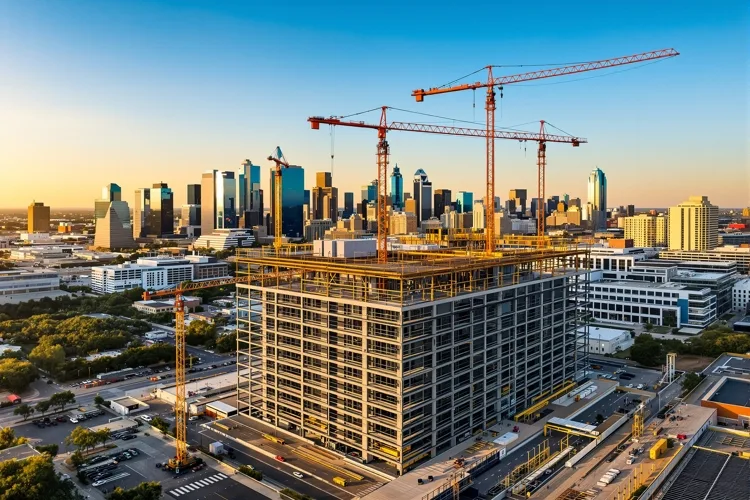
Commercial Construction Cost in Dallas 2026: What Every Project Owner Needs to Know
Commercial Construction11 min read2026-08-13

Commercial Construction Cost in Dallas 2026: What Every Project Owner Needs to Know

Clark Richardson

Clark Richardson

Project Manager

Share

I am Clark Richardson, Project Manager at UTS BuildPros. I coordinate commercial construction projects across Dallas, Fort Worth, and the surrounding DFW metroplex — negotiating bids, managing subcontractor schedules, and holding scope meetings that keep projects on time and on budget. When a client calls me and asks what a commercial building costs to construct in Dallas, my answer is always the same: it depends on what you are building, where exactly you are building it, and the decisions you make in preconstruction that most owners do not think about until it is too late.

In 2026, the Dallas commercial construction market has stabilized from the extreme volatility of 2021 through 2023, but costs remain significantly elevated from pre-pandemic levels. Wages are growing. Energy codes are adding requirements. And the city of Dallas — along with every suburb in the metroplex — has its own permit process, its own impact fees, and its own plan review timeline that can add weeks or months to your schedule. You can see the full phase-by-phase sequence — from pre-construction through certificate of occupancy — in our commercial construction timeline guide. If you are planning a commercial project in DFW and want to understand what it actually costs, this guide is for you.

Why Dallas Is Not One Market

The first thing to understand about DFW commercial construction costs is that Dallas is not a single, uniform market. The metroplex encompasses more than 200 municipalities — Dallas, Fort Worth, Plano, Frisco, McKinney, Richardson, Garland, Irving, Arlington, and dozens more — and construction costs vary meaningfully across them. Urban infill projects in Uptown, Deep Ellum, and downtown Dallas can cost 10 to 15 percent more than comparable suburban builds in Frisco or Grand Prairie, because city sites have limited laydown space, restricted delivery hours, and tighter site logistics that translate directly into added labor hours and overhead costs. That premium shows up in the contract, and owners who budgeted based on a suburban square-foot rate for a downtown site get an unpleasant surprise during preconstruction.

The market advantage of DFW versus other Texas metros is real and significant. According to Maxx Builders, a Houston-headquartered commercial general contractor with 340+ delivered projects across the state, the overall Dallas-Fort Worth range in 2025–2026 runs $190 to $340 per square foot — consistent with the statewide average, but with faster wage growth than Houston or San Antonio due to the logistics-driven demand surge from Amazon, Meta, and major distribution operators. Their data shows skilled-trade wage growth of 5 to 7 percent annually in DFW, above the 4 to 6 percent statewide figure. You can review their complete Texas breakdown at Maxx Builders Texas commercial construction cost guide.

Commercial Construction Costs by Building Type in Dallas

The $190 to $340 range is nearly useless without building-type context. Here is how costs break down across the most common commercial project types we see in DFW, along with the factors that move the number up or down within each range.

Office and corporate construction runs $190 to $330 per square foot for standard Class A space, with tenant improvements adding $80 to $150 per square foot on top of that. Build-to-suit corporate headquarters with structured parking and premium amenity floors can push past $400 per square foot. The main cost levers in office work are elevator systems, HVAC zoning, curtain wall versus punched window systems, and the scope of the tenant buildout.

Retail and restaurant construction spans $210 to $370 per square foot for shell and buildout. Quick-service restaurants and experiential retail push the top of the range because of commercial kitchen MEP, grease interceptors, hood systems, and high-end finishes. The difference between a basic retail shell at $130 per square foot and a restaurant buildout at $370 per square foot is almost entirely in the kitchen and mechanical scope — not the structure.

Industrial and warehouse construction is the most cost-efficient segment in the DFW market. Standard tilt-wall distribution facilities run $90 to $130 per square foot for shell only. Light manufacturing and general industrial with basic systems runs $200 to $300 per square foot. Heavy manufacturing with cranes, process utilities, and climate control pushes $400 per square foot and beyond. The slab is a major driver in industrial work — manufacturing floors need 6 to 10 inches of reinforced concrete rather than the 4-inch slabs that warehouses use, and that difference in concrete weight and rebar is not trivial.

Medical and healthcare is the highest-cost commercial segment in DFW, running $270 to $440 per square foot for most outpatient work, and higher for surgical centers and specialty imaging facilities. Medical gas systems, redundant MEP, code-driven requirements, and infection control protocols are what push healthcare above every other commercial type. If you are planning a medical office building and comparing it to an office quote, they are not remotely the same project.

What the Per-Square-Foot Number Actually Means

One of the most important conversations I have with clients is about what the per-square-foot number includes and what it does not. The $190 to $340 range you will see in any Texas commercial construction benchmark — including ours — refers to hard costs: the construction contract value. It does not include soft costs, and soft costs matter enormously.

According to Terrapin Construction Group, a national design-build and commercial general contractor operating across 38 states, soft costs typically add 15 to 30 percent on top of hard construction costs. Their breakdown includes architectural and engineering fees at 5 to 12 percent of hard cost, permitting and impact fees, insurance, construction loan carrying costs, project management, and FF&E procurement. On a $10 million hard-cost commercial project in Dallas, that means $1.5 to $3 million in additional soft costs — money that must be in your pro forma from day one. Their complete commercial construction cost reference is available at Terrapin CG commercial construction costs guide.

In the Dallas context specifically, the permitting side of soft costs deserves its own conversation. We walk through the full Dallas sequence — HOA approval, zoning verification, plan review, coordinated inspections, and certificate of occupancy — in our Dallas commercial permits guide. Commercial permits in Dallas proper take 90 to 150 days under the city’s tiered plan review system. Suburban jurisdictions like Plano and Arlington run 60 to 100 days. Frisco runs 75 to 120 days. Every day in plan review is a day you are paying construction loan interest without breaking ground. If you buy land, sign a construction loan, and then discover your permit will take five months instead of two, the carrying cost hit is real and compounding.

The Local Cost Drivers That Move Your Number

Beyond the building type and the market context, several DFW-specific factors move commercial construction costs up or down in ways that a per-square-foot benchmark cannot capture.

Labor market pressure is the most persistent cost driver in 2026. Dallas construction wages are growing at 4 to 6 percent annually across most trades, and the skilled labor shortage affects mechanical and electrical work particularly hard. EB3 Construction, a Dallas-based commercial general contractor, reports in their 2026 Dallas cost guide that DFW’s large subcontractor network helps prevent the extreme pricing spikes seen in smaller markets, but wage growth paired with scheduling pressure is still pushing project costs beyond initial budgets for owners who do not lock pricing early. Their full analysis is available at EB3 Construction Dallas commercial construction estimate guide.

Material costs have stabilized compared to the 2022–2023 peak but remain 20 to 35 percent above 2019 levels across most categories. Structural steel lead times still run 14 to 22 weeks. MEP equipment and switchgear can run 40 weeks or more. Concrete ready-mix is up 2 to 3 percent annually, driven partly by driver shortages. For projects with 12 or more months of construction duration, these lead times are not just procurement footnotes — they are schedule constraints that must be built into the critical path.

Energy code compliance is adding measurable cost in 2026. Updated IECC 2021 standards are now in effect across most DFW jurisdictions and add approximately 1 to 3 percent to baseline construction costs through enhanced HVAC efficiency minimums, higher insulation R-values, and expanded lighting controls. EB3 notes that this code-driven cost impact is especially significant in industrial projects that previously had simpler mechanical requirements. Office buildings with existing efficiency standards see smaller impacts. Either way, it is a real line item that owners need to budget for.

Site conditions vary dramatically across the DFW patchwork of soils. North Texas clay expands and contracts with moisture, requiring post-tensioned slabs or drilled-pier foundations in many locations. Site work and drainage add $5 to $15 per square foot on a typical commercial project, and challenging soil or off-site utility extensions can push that to $15 to $45 per square foot according to Maxx Builders’s breakdown. Skipping the geotechnical report to save a few thousand dollars upfront is one of the most expensive mistakes a DFW commercial developer can make.

Delivery Method: The Most Underrated Cost Lever

How you structure your project delivery — not just what you build — has a measurable impact on cost. Design-build delivery consistently reduces total project costs by 8 to 12 percent compared to traditional design-bid-build approaches, according to EB3 Construction’s analysis of their own DFW project data. The integrated project team structure minimizes change orders, accelerates schedules, and allows constructability input during design when changes are still cheap.

Maxx Builders’s statewide data supports this: design-build projects — which now account for more than 55 percent of Texas commercial construction starts — deliver 6 to 10 percent cost savings on average by bringing the contractor into the process at schematic design rather than after construction documents are complete. At UTS BuildPros, we use this same principle. Our preconstruction team engages with architects and owners during design to catch scope creep, flag long-lead items early, and build a realistic schedule that reflects how the Dallas subcontractor market actually works.

CMAR delivery — Construction Manager at Risk — is the other format worth understanding. It provides the cost certainty of a Guaranteed Maximum Price while maintaining owner control over design. For larger or more complex commercial projects in DFW, CMAR is often the right structure when an owner has strong design preferences but wants the financial protection of a GMP.

Contingency: What the Market Actually Requires

Most owners hear “contingency” and think of it as padding. It is not padding — it is the financial recognition that construction in an active market carries real uncertainty. In normal conditions, I recommend a 10 percent combined contingency. In the current DFW market, with 4 to 6 percent annual wage escalation, long material lead times, and evolving code requirements, I recommend 15 percent minimum for most commercial projects.

Maxx Builders structures contingency across three buckets: design contingency at 5 to 10 percent during early design phases, construction contingency at 3 to 5 percent after GMP is established, and owner contingency at 3 to 5 percent outside the construction contract. For a $5 million DFW commercial project, these three buckets together represent $550,000 to $1,000,000 that should be in your project budget on day one — not discovered missing after the GMP is signed.

Real-World DFW Commercial Cost Examples

To make the benchmarks concrete, here are several project types we have priced or completed in the Dallas-Fort Worth market in 2025–2026. A 14,000-square-foot multi-tenant retail strip in North Dallas — shell, site work, and tenant improvements — delivered at approximately $247 per square foot total. A 65,000-square-foot tilt-wall distribution warehouse in Fort Worth, including site work, dock equipment, and a 5,000-square-foot office buildout, delivered at $150 per square foot. A medical office building in a North Dallas suburb — full MEP, medical infrastructure, and tenant improvements — ran approximately $370 per square foot. These are real numbers, not benchmarks, and they reflect the scope decisions that define what you actually build.

Planning a commercial project in Dallas-Fort Worth? Get a real preconstruction estimate.

What You Can Do Right Now to Protect Your Budget

The clients who consistently come in close to budget on DFW commercial projects are the ones who engage their contractor during schematic design rather than after construction documents are stamped. Bringing a contractor in early — at schematic design, not permit-ready design — saves 5 to 12 percent of total project cost through constructability review, material selection guidance, and trade coordination that is far cheaper to fix on paper than in the field.

Lock in subcontractor pricing early, especially for structural steel, MEP equipment, and any electrical gear with long lead times. Verify zoning, permit timelines, and impact fees before signing a land purchase contract — not after — and study the full Dallas commercial permits process before you commit. Get a geotechnical report before finalizing your foundation design. And compare bids on an apples-to-apples basis: every line item, every exclusion, every assumption documented in writing so you are not choosing between a complete scope and a scope with hidden gaps.

At UTS BuildPros, we build commercial projects across Dallas, Fort Worth, and the surrounding metroplex. If you are planning a commercial construction project in DFW, contact UTS BuildPros for a free preconstruction consultation. We will review your site, your scope, your timeline, and your budget — and give you honest, line-item numbers that reflect what Dallas commercial construction actually costs in 2026.

Frequently Asked Questions

Quick answers to the most common questions about this topic

Have a question not answered here?

Ask Our Team

Related Service

Interested in commercial construction? Learn more about how UTS BuildPros can help.

Explore Commercial Construction

Ready to Start Your Project?

Get a free consultation and detailed estimate from our veteran-owned construction team.